This week a colleague refactor a script that I wrote and the end was pretty different from what I did. The logic was the same but the code was very differnt. I learnt two things about python
setattr: This method provides an alternate means to assign values to class variables, in addition to constructors and object functions. It comes in handy when we want to add a new attribute to an object and assigning it a value
cycle: . This function takes an iterable inputs as an argument and returns an infinite iterator over the values in inputs that returns to the beginning once the end of inputs is reached.
In one meeting somebody mentioned CXL, and I had to look it up.
Interesting:
Eventually CXL it is expected to be an all-encompassing cache-coherent interface for connecting any number of CPUs, memory, process accelerators (notably FPGAs and GPUs), and other peripherals.
BFD is a protocol that I assumed I knew “well” as it is quite straightforward…. But after having to check how to configure BFD multihop works I notices, I had actually no idea. As usual, I need to read the RFC at some point.
From this link, I noticed that the concept of Hellos and Echo…. and that echo uses the same IP as src and destination…. I really like the wireshark captures.
Copy/Paste from the link
Packet Types

Control Packets

Control packets are used to establish BFD peerings. Essential information are included within these packets, to include flags for things such as authentication, in addition to the timer negotiations.
These packets are send via UDP to the destination of the far side IP, utilizing the bfd-control port of 3784.
Because these packets must actually be processed by the peer, they are sent less frequently then the actual BFD echos used for sub second failure detection.


Echo Packets

BFD echo packets are essentially for local use. They are sent with the same source, and destination IP of itself, destined for the UDP bfd-echo port of 3785. When an echo packet is received, because the destination IP is not of the router receiving it, it simple forwards it out of the appropriate interface, ridding the need to punt it up to the processor.
Because the source and destination IP are the local router, BFD can be ran asynchronous. As in, you can set up a single side to utilize BFD echo detection, while the other side merely maintains a BFD neighbor relationship through control packets.
And now about the BFD multihop. It is a short read, and main point is the UDP port is 4784 compared with 3784 in single-hop.
Then checking for the specific details for configuring BFD MH in NX-OS, it is better to check the official documentation. That for example confirms “Echo mode is not supported for multihop BFD.”
Another thing to take into account is the COPP. You need to check if your device OS captures BFD in the CoPP policies as multi-hop goes to CPU. As well, check if there is any other hardware configuration required.
Another thing that bites me is that when testing this in a software lab, BFD is always down but at least the routing protocols come up.
I watched this week some interesting videos from NVIDA GTC related to networking. And it is a pain that you need to use a “work” email to register….
S51839 – Designing the Next Generation of AI Systems:
— A quick summary, it seems any HPC networks needs to use InfiniBand… NVIDA has solution for all sizes. They can provide a POD solution!!! All Cloud providers provide their services.
S51112 – How to Design an AI Supercomputer for Fast Distributed Training, and its Use Cases:
— Very interesting talk from NEC Japan. They built a network based on Ethernet switches for HPC with GPUs (and not IB as seen in the other video). As well they are heavy in RDMA/ROCEv2. And seems they have dedicated ports in the network for storage, management, etc. They are very happy with Cumulus/Linux as NOS.
S51339 – Hit the Ground Running with Data Center Digital Twin Automation:
— Interesting tool NVIDIA air for creating labs. I expected in the demonstration to show off and built a huge network. “Digital Twin” looks like the new buzzword in the network automation world.
S51751 – Powering Telco Cloud Services with Open Accelerated Ethernet:
— This is from COMCAST. And it is very interesting how “big” looks like SONIC is becoming. And NVIDIA is the second contributor to SONIC after M$! I need to try SONIC at some point.
S51204 – Transforming Clouds to Cloud-Native Supercomputing Best Practices with Microsoft Azure:
— Obviously, building NVIDIA based supercomputers in M$ Azure. Again, all infiniband.
And another thing, the Spectrum-4 switch looks insane.
I watched very interesting videos about AWS networking. They are high level, so they dont tell you the magic sauce you would like to know but it is nice that this info is out in the public.
DKNOG – How AWS is evolving its peering-edge in 2023 and onwards link + event:
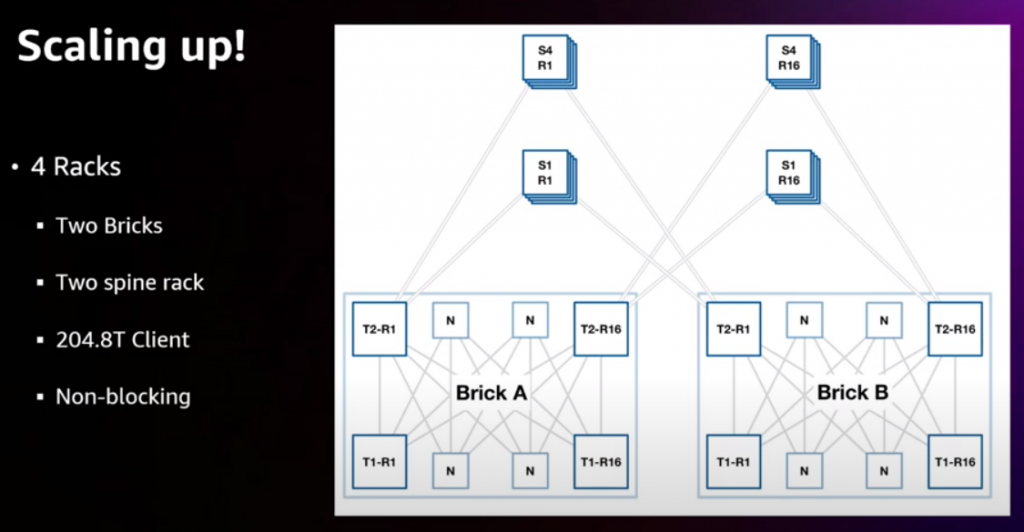
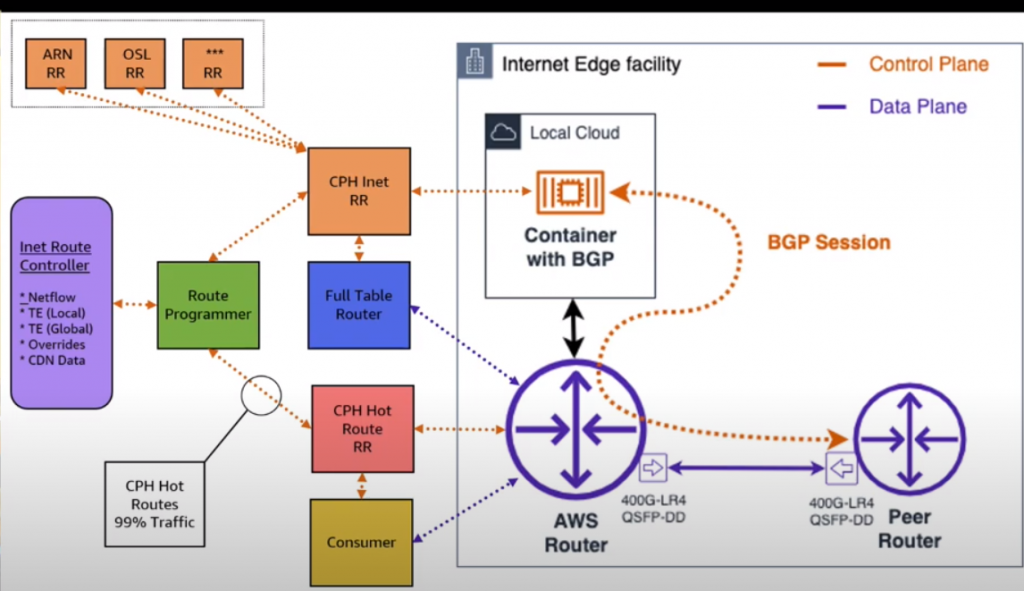
— Evolution from buying chassis to building your own devices: consume -> create (NOC-less, auto-remediation, active telemetry, etc)-> innovate (freedom to examine trade-offs, 1U devices). Clearly use of “Clos” networks and they linux-based software.
— Delighted: low complexity + high innovation
— Simplicity Scales
— It is interesting the view of a router/brick like a set of 1U devices (rack 102.8T – 200x400G ports for customers, non-blocking). An it is very good they have pictures of the concept of “bricks” and “spines”.
— Challenges with cabling (SN connector — no patching rack needed) and 400G ZR+ (heating!)
AWS re:Invent 2022 – Dive deep on AWS networking infrastructure (NET402)– link
— summary: This is “similar” to the DKNOG but with longer and some other details like:
— “We dont like chassis”. 1+million devices
— SDR at NIC level so one TCP flow is actually load-balanced in several paths
— Hybrid SDN approach: You have controllers to give you a big picture view (I guess it provides the visibility to say “just send 70% traffic to this device” – but not sure how) and the own device device capability to deal with changes.
— Telemetry, continuous monitoring, triangulation: Be able to detect the port/device is causing the problem.
AWS re:Invent 2022 – Leaping ahead: The power of cloud network innovation (NET211-L) – link:
— AWS Global Infrastructure: Backbone capacity
— Customer SW/HW
— Everything fails all the time
— GPS locations in fibers! + inject light in fiber to double check fault -> intelligent optical routing/failover -> better than BGP….
— Termite sheet fibers for Australia 🙂
— Nitro card = NIC (offload card)
— SDR: not need in-order packet deliver as required by TCP. 25Gbps flows allowed now.
This is the last book from the original Dune series. Thinking of the first books, looks like a different world although there are references to the beginning. The end is quite open so you can think this is can continue in more books as with the time there is always a new plot/drama. Although there are many things I dont understand. The couple of “Face Dancers” in contact with Duncan? I like the references to Van Gogh pictures like “Thatched Cottages at Cordeville“.
I would never think that Duncan would be present in all books and being a critical character.
But at the end, all is about love and the repression of it like Bene Gesserit do.
And quite moving the last words from the author about his wife death.
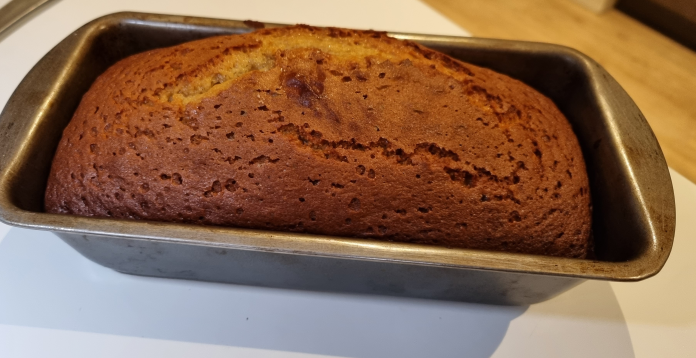
This is a typical Southern Portugal cake that I tried two Christmas and quite liked as looks simple and tasty. So finally this weekend was the time to try this recipe.
Ingredients:
2 medium eggs
100g sugar
100g honey
75ml olive oil
150g plain flour
1/2 tbs cinnamon
1/2 tbs baking powder
1/2 ground anise grains.
A bit of butter
Process:
Pre-heat oven at 180C
Whisk eggs and sugar until double in volume. It takes time doing it by hand!
Add honey and oil, bit a bit and keep whisking.
Add flour, cinnamon, baking powder and anise. Mix all well
Pour the mix in a greased tin.
Bake for 45 minutes aprox. Use a tooth stick or similar to check the inside is cook before removing from oven.
Result:
It raised more than I expected. It wasn’t as moist as I remember but it was tasty. Based on the ingredients reminded me of a olive-Greek cake I did some months ago.
I checked other recipes like this so maybe I will try again at some point.
Somehow I came across this company that provides some crazy numbers in just one rack. Then again nearly by coincidence I show this news from an email that mentioned “cerebras” and wafer-scale, a term that I have never heard about it. So found some info in wikipedia and all looks like amazing. As well, I have learned about Gene Amdahl as he was the first one trying wafer-scale integration and his law. Didnt know he was such a figure in the computer architecture history.
1/2 lemon skin cut at julienne (long and narrow stripes)
50ml water
50g caster sugar
1/2 lemon juice
Process:
Mix water and sugar in a pan. Heat up to boil water.
Add the lemon zest and mix for 10 sec, while water is boiling
Add lemon juice and keep mixing for another 10 sec.
Check the mix is getting some consistency then remove from heat
Let it cool down for later. It should be like a syrup and solidify while cooling down. You can heat it up in microware for 10-15s to make it liquid again.
Lemon Pudding souffle ingredients:
125ml milk
35g butter
70g caster sugar
70g plain flour
2 eggs yolks
4 eggs whites
1/2 tsp vanilla paste
1/2 lemon zest
butter and sugar for greasing
Process:
Pre-heat oven at 180C
Grease (solid butter and sugar) 4 dariole moulds. Be sure there is no shiny parts! Cut a small square of baking paper and put in the bottom of the mould.
Make a “beurre manie” that is mixing the butter and flour by hand in a bowl.
Scold the milk with the vanilla (just hit the boiling point). Then at medium heat, add pieces of the “beurre manie” and whisk non stop with the milk. It is like doing “bechamel” sauce. Once the whisk is not useful, move to a wooden spoon and keep mixing.
At the end you will have kind off a ball, keep cooking for 1-2 minutes to be sure the flour is properly cooked.
Remove from heat and let it cool down
Add the 2 egg yolks one at each time to the “ball”. It should become like a thick cream.
Whisk the egg whites until snow peak. Then add the sugar and lemon zest and whisk again until snow peak. This is the meringe
Now fold a 1/3 of the meringe into the pudding butter. Keep doing the same 1/3 at the time.
Once you have all mixed, pour the butter into the moulds up to 3/4.
Using a deep tray, put the moulds and fill it with water (hot if possible). Be careful the moulds dont float!
Bake for 20-25 minutes until golden on top and risen.
Prepare the egg custard while waiting
Fresh egg custard sauce ingredients:
75ml double cream
75ml milk
35g egg yolk
25g caster sugar
1/2 tbs vanilla paste
Process:
In a glass, mix egg yolks and sugar.
Mix double cream, milk and vanilla in a sauce pan. Add a bit of the sugar and put to the boil.
Add the egg mix to the liquid and mix with a wooden spoon.
Keep mixing until the liquid thick up a bit! Dont over do it! If you ran a finger in the back of the spoon when covered with the custard, it should keep apart.
Remove from heat and pour it in a container. Cover with cling film
Presentation:
Once the pudding moulds are ready, remove the mould, be sure you take off the paper too!
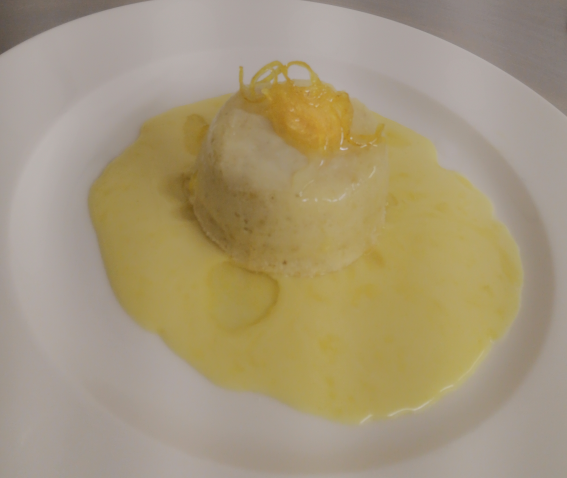
Put each pudding in the middle of a dish.
Pour the custard around the pudding
Put a spoon of the lemon syrup on top of the pudding (put in microware if solid)